


MANILA, Philippines — Former Philippine president Rodrigo Duterte will not personally attend the first status conference of his case before the International Criminal Court scheduled for May 27, after his legal team formally submitted a signed waiver before the tribunal.
DEFENSE FORMALLY SUBMITS SIGNED WAIVER
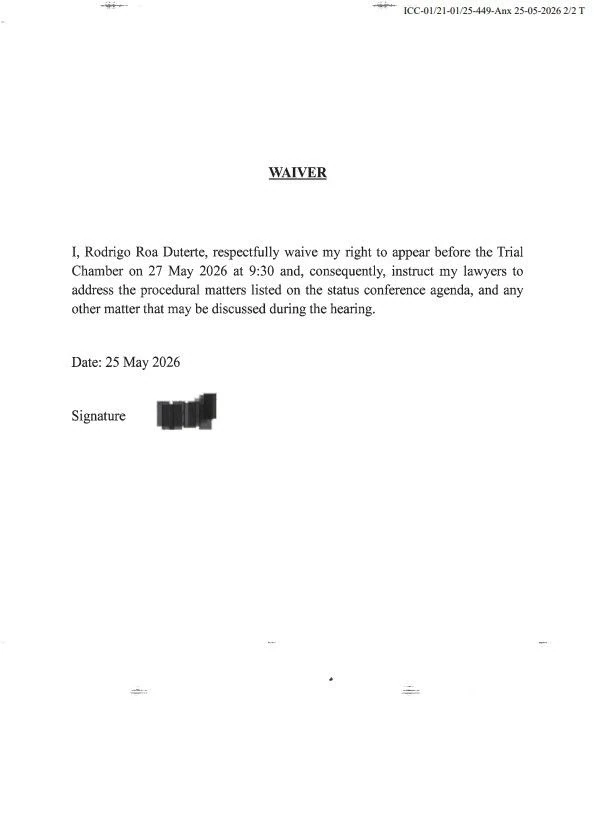
The confirmation came after Duterte’s legal team filed a public notification before ICC Trial Chamber III stating that the former president had signed a waiver allowing him to be absent from the initial proceedings.
The filing complied with an order issued by the court on May 22 directing the defense to submit a written waiver on record no later than May 25.
DUTERTE LEAVES PROCEEDINGS TO LEGAL TEAM
According to the submission filed by lead counsel Peter Haynes, Duterte has authorized his legal representatives to fully handle the upcoming hearing and other procedural matters that may arise during the conference.
The filing stated that Duterte instructed his lawyers to address agenda items listed for the status conference, as well as any additional issues that could be raised during the proceedings.
Earlier communications from the defense also emphasized that the former president had expressed full trust in his legal team to represent his interests before the court.
PANEL OF JUDGES TO OVERSEE PROCEEDINGS
The status conference will be presided over by Joanna Korner alongside Keebong Paek and Nicolas Guillou.
The proceedings fall under the ICC case involving the ongoing situation in the Philippines.
Background: ICC investigation into Duterte-era drug war
The ICC has been investigating alleged crimes against humanity connected to anti-drug operations carried out during Duterte’s administration. The tribunal has maintained that it retains jurisdiction over alleged crimes committed while the Philippines was still a state party to the Rome Statute, despite the country’s withdrawal from the court in 2019.
Duterte and his allies have repeatedly questioned the ICC’s jurisdiction over the Philippines and have consistently defended the anti-drug campaign implemented during his administration.