


TAIPEI- As families in Taiwan marked the Qingming holiday, a long-standing national debate resurfaced: should the island deepen its reliance on the United States for defense, or ease tensions by strengthening ties with China?
The renewed discussion comes as the ongoing Iran conflict raises concerns about Washington’s ability to manage multiple global crises simultaneously.
Questions over delayed arms deliveries, shrinking US weapon stockpiles, and President Donald Trump’s transactional foreign policy have intensified doubts among Taiwanese observers.
IRAN WAS SPARKS DOUBTS OVER US RELIABILITY
The war in Iran has amplified fears that US attention and resources may be stretched thin. Analysts warn that prolonged military engagement in the Middle East could divert focus away from the Indo-Pacific region.
William Yang, a senior analyst at the International Crisis Group, noted that such a shift may reduce pressure on China while leaving Taiwan more vulnerable to both military and political coercion from Beijing.
These concerns are further fueled by existing delays in US-approved weapons systems for Taiwan, some of which have yet to be delivered years after approval.
KMT LEADER’S CHINA VISIT DRAWS GLOBAL ATTENTION
The debate has sharpened as Cheng Li-wun, chair of Taiwan’s main opposition party, the Kuomintang (KMT), embarks on a six-day visit to China.
The trip could include a high-profile meeting with Chinese President Xi Jinping in Beijing, potentially the first encounter of its kind between a sitting KMT leader and China’s top official in a decade.
Cheng described the visit as a peace initiative aimed at easing tensions across the Taiwan Strait.
“War is not inevitable,” she said, expressing hope that the trip would usher in warmer cross-strait relations.
The visit also comes ahead of a planned summit between Trump and Xi, where Taiwan is expected to be a key issue.
US PUSHES TAIWAN TO BOOST DEFENSE SPENDING
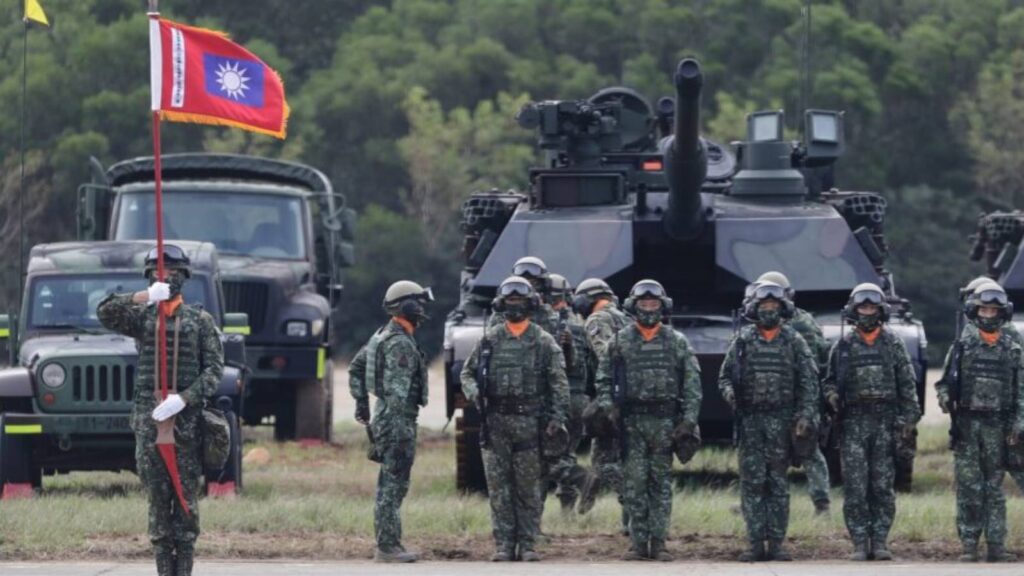
At the same time, a bipartisan group of US senators visited Taipei, urging lawmakers to approve President Lai Ching-te’s stalled $40 billion defense package.
Senator Jeanne Shaheen emphasized the need for unity in strengthening Taiwan’s defense capabilities, while Senator John Curtis stressed that Taiwan must demonstrate it is contributing to its own security.
However, opposition lawmakers have resisted the proposal, citing delays in existing US arms deliveries and calling for greater transparency and oversight.
POLITICAL DIVIDE: DETERRENCE VS DIALOGUE
Taiwan’s internal political divide has become more pronounced.
For the ruling Democratic Progressive Party (DPP), security lies in closer ties with Washington and stronger military deterrence.
In contrast, the KMT argues that reducing tensions with Beijing is the most effective way to prevent conflict.
Political analyst Lev Nachman explained that both parties are presenting competing visions to the public, one focused on military strength, the other on diplomatic engagement.
Still, neither side advocates completely severing ties with either power; the disagreement centers on which relationship should take priority.
CHINA’S PRESSURE CAMPAIGN CONTINUES
China has maintained steady pressure on Taiwan through near-daily military activity, including aircraft and naval operations around the island.
Taiwanese officials also accuse Beijing of spreading disinformation and exploiting political divisions domestically.
At the same time, China has refused to engage with Taiwan’s current government, led by the DPP, due to its rejection of Beijing’s sovereignty claims and the so-called “1992 consensus.”
The KMT, however, supports this framework, allowing its leaders to maintain communication with Chinese officials.
PUBLIC SENTIMENT: CAUGHT BETWEEN TWO POWERS
Many Taiwanese citizens feel caught between competing global forces.
Taiwan’s transformation into a vibrant democracy since the 1990s and its dominance in advanced semiconductor production have elevated its global importance but also increased strategic pressure.
Located along the “first island chain,” Taiwan is seen as a critical geopolitical flashpoint by both China and the United States.
While support for unification with China remains low, most Taiwanese favor maintaining the status quo and avoiding war.
“TAIWAN WANTS IT ALL”
Cheng has framed her party’s position as pragmatic, rejecting the idea that Taiwan must choose between Washington and Beijing.
“Little children choose. Taiwan wants it all,” she said, emphasizing a balanced approach.
Her message resonates with voters wary of conflict but skeptical of China’s intentions—particularly in light of Beijing’s crackdown in Hong Kong despite earlier promises of autonomy.
UNCERTAIN OUTCOMES FROM CHINA VISIT
Despite the high stakes, expectations for Cheng’s visit remain cautious.
Some Taiwanese citizens view the trip as a necessary effort to reduce tensions, while others doubt it will produce lasting results.
Observers say any improvement in relations may only be temporary, as China’s long-term stance on Taiwan remains unchanged.
TAIWAN AT THE CENTER OF GREAT POWER RIVALRY
Taiwan’s geopolitical significance has made it a focal point of US-China tensions for decades.
- The island split from mainland China in 1949 after the Chinese civil war.
- Beijing considers Taiwan a breakaway province and has not ruled out the use of force for reunification.
- The United States maintains unofficial ties with Taiwan and is its primary arms supplier under the Taiwan Relations Act.
- Taiwan is a global leader in semiconductor manufacturing, producing the majority of the world’s most advanced chips.
Recent global conflicts, including the war in Iran, have heightened concerns about how major powers allocate military resources, raising new uncertainties for Taiwan’s security.