


MELBOURNE, Australia – U.S. Army Pacific Commanding General Charles A. Flynn gathered with senior military leaders from Australia, Japan, the Philippines, and the Commander of the III Marine Expeditionary Force at Victoria Barracks, Melbourne.
The high-level summit aimed to discuss strengthening multilateral deterrence in the Indo-Pacific region amid escalating tensions and rising security threats.
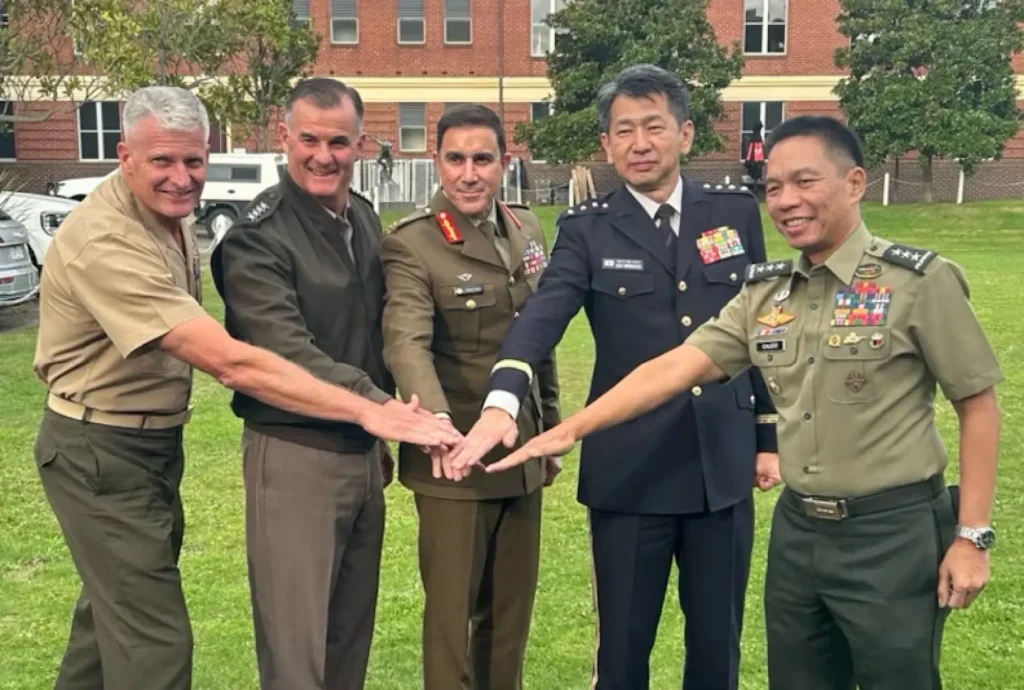
During the meeting, the allied leaders reached critical agreements to enhance cooperation among their respective land forces.
These agreements include expanding the timing, scale, and complexity of army-to-army exercises while shifting from bilateral frameworks to multilateral integration. These new measures are designed to counter growing threats posed by China’s aggressive actions in the South China Sea and North Korea’s missile tests.
“This is the deepest level of integration among U.S. regional allies I have ever seen,” General Flynn remarked. “Not only during my tenure as the commanding general but over the course of my entire career.” Flynn emphasized the importance of this enhanced collaboration in preparing the region’s militaries to respond to potential threats more effectively.
The summit comes on the heels of several landmark policy developments that have paved the way for increased multilateral defense efforts. Among these is the Reciprocal Access Agreement between Japan and the Philippines, signed in July 2024, and another between Australia and Japan, signed in 2022.
Additionally, during the 2024 U.S.-Australia Ministerial Consultations, the two nations agreed to upgrade key military bases, establish a permanent Logistics Support Area in Queensland, and enhance interoperability with other Pacific nations.
The leaders discussed various options to improve regional deterrence, including adjusting the timing of key military exercises.
One significant move was the decision to shift the U.S.-Japan Yama Sakura command post exercise to August, coinciding with China’s People’s Liberation Army’s annual large-scale exercise.
Yama Sakura, traditionally a bilateral exercise, now regularly includes Australia’s 1st Division and will soon involve a full Philippine Army Division, marking a notable shift toward deeper multilateral cooperation.
Amid the deteriorating security environment, with heightened Chinese aggression in areas like Second Thomas Shoal and Sabina Shoal, the summit emphasized the urgency of a collective response.
The Philippine Army, frequently harassed by Chinese vessels, will expand its participation in the U.S.-Philippine Balikatan exercises.
Balikatan, which translates to “shoulder-to-shoulder,” is set to undergo a full battle test to assess the Philippines’ defense strategies with U.S. assistance.
The leaders also discussed how to incorporate Australian and Japanese forces into the army-to-army portion of the Balikatan exercise.
Another significant point of discussion was Australia’s role as the host of the 2025 Talisman Sabre exercise, which is expected to involve over 30,000 personnel from 17 countries.
Talisman Sabre is set to become the largest multilateral exercise in the region, spanning the entire Australian continent and including demonstrations of newly fielded multidomain capabilities.
The meeting concluded with the allied leaders agreeing to maintain a regular schedule of meetings to ensure their forces remain aligned and capable of responding to regional challenges.
General Flynn emphasized the importance of combining credible capabilities with the necessary political and military will to deter aggression.
With tensions at an all-time high, the collaboration between the U.S. and its regional allies is poised to play a critical role in maintaining peace and security across the Indo-Pacific.