


TENSIONS sharply escalated on the 23rd day of the war involving the United States, Israel, and Iran, as Tehran warned of severe retaliation following threats from US President Donald Trump to strike Iranian power plants.
Iranian officials cautioned that any attack on their energy infrastructure could trigger widespread destruction across the Middle East, potentially causing “irreversible” damage to critical facilities in the region.
Trump, in turn, issued an ultimatum demanding that Iran fully reopen the Strait of Hormuz, a vital global oil shipping route, within 48 hours.
He warned that failure to comply would result in US airstrikes targeting Iran’s power infrastructure, signaling a significant intensification of rhetoric and pressure.
![Israeli rescue crews comb through the debris of residential buildings in Beersheba following destruction caused by an Iranian missile strike. [Leo Correa/AP Photo]](https://news.bomboradyo.com/wp-content/uploads/2026/03/Israeli-rescue-teams-1024x683.webp)
Israeli rescue crews comb through the debris of residential buildings in Beersheba following destruction caused by an Iranian missile strike. [Leo Correa/AP Photo]
KEY DEVELOPMENTS
Escalating Threats and Responses
Trump’s warning to “hit and obliterate” Iran’s power plants marks one of the strongest threats yet, underscoring the strategic importance of the Strait of Hormuz, which Iran has used as leverage amid ongoing disruptions.
In response, Iranian leaders vowed retaliation, warning that energy and infrastructure targets across the Middle East could be devastated if strikes proceed.
Civilian Impact and Ongoing Strikes
Israeli Prime Minister Benjamin Netanyahu condemned Iran after missile strikes hit civilian areas, including the southern Israeli city of Arad, where at least 84 people were injured, 10 critically.
Another strike in Dimona caused additional casualties and property damage.
Meanwhile, Israel reported launching large-scale coordinated strikes over the weekend against more than 200 targets in Iran and Hezbollah positions in Lebanon, including weapons depots and command centers.
Lebanese President Joseph Aoun warned the attacks could signal a potential ground invasion.
Rising Casualties and Displacement
The humanitarian toll continues to climb. Iranian sources report over 18,000 civilians injured and more than 1,330 deaths, including at least 200 children, since the war began three weeks ago.
In Lebanon, over 1,000 people have been killed, with more than one million displaced.
Regional and Global Security Concerns
Missiles were also reportedly launched toward the US-UK military base in Diego Garcia, drawing condemnation from the United Kingdom. Meanwhile, a helicopter crash in Qatar killed seven people, including foreign nationals.
Israel is also investigating a possible “friendly fire” incident that may have killed a civilian in northern Israel, initially believed to have been caused by Hezbollah.
Strait of Hormuz Tensions
Iran stated the strategic waterway remains open except to its “enemies,” while simultaneously threatening to shut it down indefinitely if attacked. Several nations, including the United Arab Emirates and Australia, have signaled willingness to help secure safe navigation in the area.
An explosion near a commercial vessel off the UAE coast further heightened concerns about maritime security. Since the conflict began, multiple vessels linked to US-aligned countries have been targeted in the strait.
NATO Secretary General Mark Rutte expressed confidence that international cooperation would eventually restore safe passage through the waterway.
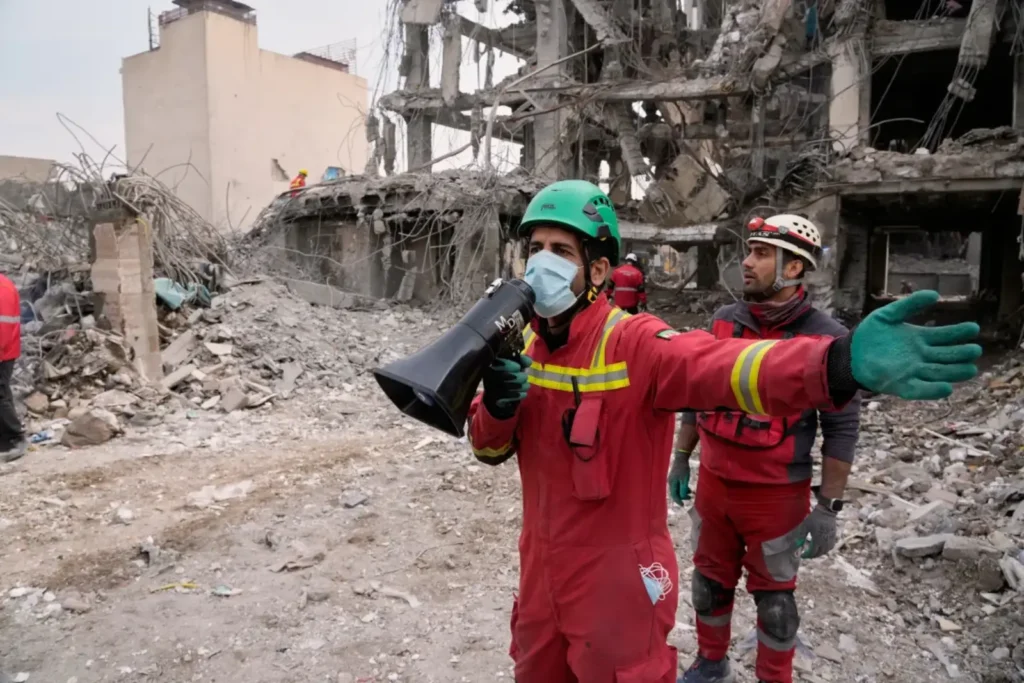
Tehran responded to US and Israeli air strikes by launching successive waves of missiles and drones targeting Israel and military bases across the Middle East hosting US forces. [Vahid Salemi/AP Photo]
Oil Prices Surge
Global oil markets reacted swiftly to the escalating tensions. Brent crude rose by 1.69% to approximately $114 per barrel, while US crude climbed 2% to over $100 per barrel, reflecting fears of prolonged disruption in one of the world’s most critical energy corridors.
Internal Crackdown in Iran
Iranian authorities have intensified internal security measures, arresting at least 25 individuals accused of spreading information about war damage and sharing it with opposition networks. The arrests follow recent executions linked to earlier anti-government protests.